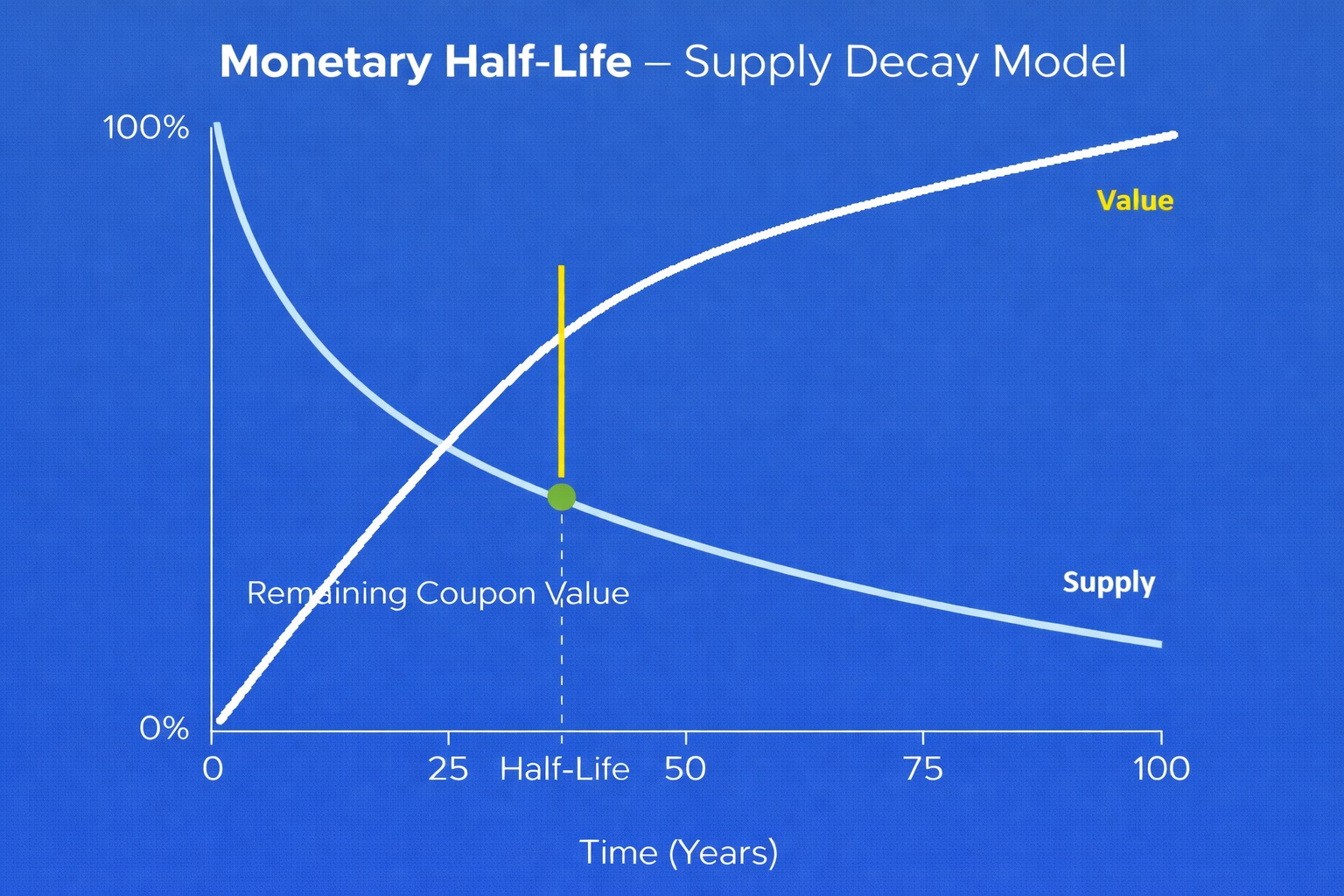
By applying an atomic half-life model, the Monetary Half-Life burn engine reduces supply based on exponential decay over time. This approach produces a predetermined and mathematically defined supply outcome at any point along the curve.
In contrast, traditional blockchain burn models are dependent on transaction volume, resulting in indeterminate supply reduction. Market conditions—whether active or slow—directly impact burn rates, (supply reduction) making outcomes unpredictable. The Rutherford-based decay model enforces a fixed relationship between time and supply, ensuring consistent and auditable results.
Our clients define both the initial supply and the decay term. For example, a system may begin with 1,000 Digital Equity Units and apply a half-life decay period of 97 or 84 years ,(any term) reducing supply along a known curve with precise values at any point in time.
Because the Rutherford model underpins this system, BZFC has embedded this structure directly into the software. With 17-decimal precision, the smallest unit is referred to as a Rutherford, or “Ruth.”
BZFC has also introduced the concept of Decay Funds, where multiple assets operating under different decay parameters can be combined into a diversified, decay-based mutual fund–style derivative. Byzantine Future capital Ltd has created a utility mechanism for clients to utilize as an in-house utility; given the life of the project BZFC anticipates broader market implications going foreword.
Half-Life 1/2, The time it takes to reduce supply by half
Part-Life 7/16, 3/8, 7/8, 3/16: The time it takes to reduce supply by any fractional amount.